

Figuring out how to get more landscaping jobs is centered on building a consistent plan that keeps the pipeline full every month of the season. Repeatable systems for getting more landscaping jobs, following up fast, and turning satisfied customers into a source of new business.
You need to start by deciding what kind of work you want more of, then putting the right tactics in place to attract it.
Start by Defining the Work You Want
More jobs is not a goal.
More design-build projects within a 20-minute drive of the shop is a goal.
Before spending a dollar on paid advertising or rebuilding a website, look at the work already on the books.
That analysis tells the company what to chase.
Chasing volume without direction is how a landscaping business ends up busier and less profitable at the same time. Every tactic below works better when it is pointed at a specific type of client and a specific service area. Companies that know their ideal client generate more qualified landscaping leads with less effort.
Turn the Landscaping Website Into a Lead Generation Tool
A landscaping website is the one marketing asset the company owns outright. It should be doing more than sitting there looking nice.
Every page needs a clear path to a quote request. That means a visible phone number, a short form that does not ask for a life story, and a call to action above the fold on the homepage. Website visitors who have to hunt for a way to contact the business will go back to search results and call the next company.
Page speed matters more than most owners think. Slow-loading pages drive up bounce rates, especially on phones, which is where most residential clients are searching from. A site that takes six seconds to load is losing leads before anyone reads a word.
One page listing every service the company offers will not rank for any of them. Landscape design, hardscape installation, lawn care, irrigation, and seasonal services each deserve their own page with real detail, project photos, and a service-specific call to action.
These dedicated landing pages are also what makes paid advertising work. Sending clicks from a patio installation ad to a generic homepage wastes the click and the money behind it.
Claim and Improve the Google Business Profile
For local businesses, the Google Business Profile is the highest-return marketing asset available, and it costs nothing. When a homeowner searches for landscaping services nearby, that listing is often the first thing they see and sometimes the only thing they act on.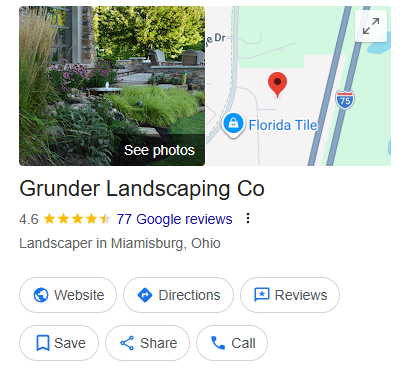
Claiming and verifying the profile is the starting point, not the finish line. What separates listings that generate calls from listings that sit idle is ongoing activity:
- Complete every service description rather than leaving generic categories in place
- Keep business hours, service areas, and contact information accurate year-round
- Upload high-quality before and after photos from real jobs on a regular schedule
- Respond to every review within 48 hours, positive or negative
- Post seasonal updates and offer promotions to stay visible in local search
Local SEO compounds. A profile maintained consistently for a year will outperform one that was set up and forgotten, even if the second company does better work. Google rewards activity, and so do potential customers who can see the business is paying attention.
Build Local SEO and Content That Attracts High-Quality Leads
Search engine optimization is what makes the phone ring without a daily ad spend. It is slower than paid advertising and far more durable.
Start with keyword research at the zip code level. The terms that matter are not broad industry phrases, they are the ones homeowners in the actual service area type in. A company serving three suburbs should have content built around those three suburbs, not the whole metro. From there, publish service pages targeting high value jobs and blog posts that answer the questions prospects ask before they call.
Title tags deserve attention too. A page titled "Services" ranks for nothing. A page titled "Landscape Design and Installation in [City]" gives search engines something to work with.
Run Google Ads When Jobs Are Needed Now
SEO builds over months. Google Ads produces landscaping leads this week, which makes it the right tool when the schedule has a gap that needs filling.
The key is intent. Search campaigns targeting terms like "landscaping company near me" or "retaining wall installation [city]" reach people who are actively looking to hire. That is different from someone scrolling a feed. Because the intent is higher, conversion rates are higher, and the cost per booked job usually justifies the spend.
Structure ad campaigns around the services that carry the best margins rather than the ones that are easiest to sell. Then send every campaign to a matching landing page. A hardscape ad goes to the hardscape page, a maintenance ad goes to the maintenance page. Matching the message to the page is the single biggest driver of PPC campaign performance for landscaping businesses.
Set a realistic geographic radius. Nothing burns budget faster than paying for clicks from homeowners 45 minutes outside the service area.
Use Social Media, Retargeting, and Email to Stay in Front of Prospects
Landscaping is a visual business, and social media marketing is where the work does the selling.
 Before and after project photos consistently outperform every other type of post. A retaining wall going in, a bed edged and mulched, a patio taking shape over three days: this is the content that makes a homeowner tag their spouse and start a conversation. Posting two or three times a week consistently beats posting fifteen times in one week and disappearing for a month.
Retargeting ads deserve more attention than most companies give them. A website visitor who looked at the patio page and left is a warm prospect. Showing that person project photos over the following two weeks costs very little and brings a meaningful percentage of them back.
Email is what connects everything. Most homeowners researching landscape work are not ready to sign anything the day they first find the company. An email sequence with seasonal tips, project features, and occasional service discounts keeps the business top of mind through a consideration period that can run months. It also gives the company a direct line to past customers for upsells and seasonal services. More on building the full channel mix is in our blog on how to advertise a landscaping business.
Build Referral and Review Systems That Run Themselves
Word of mouth is still the strongest lead source in this industry. The difference between companies that get a trickle of referrals and companies that get a steady stream is that the second group made it a process instead of a hope.
A referral program works when it is simple and specific. Cash rewards, account credit, or a free service visit all work. What matters is that existing customers know the program exists. Mention it at job completion, include it in every invoice, and put it in the email newsletter.
Reviews follow the same logic. The right moment to encourage satisfied customers to leave one is the day the job is finished, while the result is fresh and the client is happy. Send a direct link by text so the whole thing takes 90 seconds. Volume matters in local search: a landscaping company with 60 recent reviews will consistently outrank one with 12, even when the work is comparable.
Track where referrals come from in the CRM. Knowing which past customers, real estate agents, or local business groups send the most work tells the company where to invest relationship time.
Close More of the Leads Already Coming In
Plenty of landscaping companies do not have a lead problem. They have a follow-up problem. Generating more clients is pointless if a third of the leads already in hand never get a callback.
Qualify incoming leads early. A few questions about project scope, timeline, and budget range sort the serious prospects from the tire kickers and protect the estimating time that should be going toward high-value jobs.
Standardize estimate templates so proposals go out in a day instead of a week. Speed wins work in this industry more often than price does. The company that responds first is frequently the company that gets the job, and following up on every quote within 24 hours costs nothing but discipline. Then keep following up. Plenty of sales are lost to silence, not always to a competitor.
Let Branding and Local Presence Do the Work
Branded trucks, clean uniforms, and consistent signage turn every job site and every drive across town into advertising. Homeowners notice the crew that looks organized and professional, and that impression shapes whether they call.
Yard signs remain one of the cheapest lead sources available. A sign at a completed project in a desirable neighborhood reaches exactly the audience the company wants, and neighbors who watched the work happen are already half sold.
Local networking rounds it out. Business groups, chamber events, and relationships with real estate agents, nurseries, hardware stores, and general contractors produce referrals that convert at higher rates than any paid channel. These relationships take time, which is precisely why the companies that build them hold an advantage that is hard to copy.
Pursue Higher-Value and Commercial Work
Twenty small jobs and four large ones can produce the same revenue with very different profit and very different strain on the crews.
Identify the neighborhoods where high value jobs concentrate and market there deliberately with direct mail, targeted ads, and yard signs. Build out service pages for design-build and hardscape work so the site attracts those searches rather than only maintenance inquiries.
Commercial work adds another layer of stability. Property managers and HOAs bring recurring contracts and multi-property upsell potential, though they require tailored proposals, proper insurance, and back-office capability.
Track the Numbers and Adjust
Marketing that is not measured cannot be improved. The metric that matters most is not leads or clicks. It is cost per booked job by marketing channel.
Track it for every source: organic search, Google Ads, social media, referrals, yard signs. Some channels will look expensive until the average job value is factored in, and others will look cheap until the close rate is examined. Performance data settles those arguments.
From there, A/B test landing pages to lift conversion rates, shift ad budget toward the keywords producing booked work, and cut what is not performing. Small adjustments made monthly compound into a materially better return by the end of the season.
Building a Pipeline That Holds
Getting more landscaping jobs comes down to a small number of things done consistently: a website and Google Business Profile that convert, local SEO that brings in qualified leads, targeted advertising when the schedule needs help, referral and review systems that turn happy clients into new ones, and a sales process fast enough to close what comes in.
None of these tactics is complicated on its own. The advantage belongs to the companies that run all of them together, month after month, and keep adjusting based on what the numbers show. Do that, and the question stops being where the next job comes from and starts being which jobs to take.

About The Grow Group
Led by Marty Grunder, The Grow Group is a premier coaching and education firm for landscape professionals. We provide innovative events like our annual GROW! Conference, peer groups, and real-world resources to help landscaping business owners and their teams succeed. Everything we teach is based on what we know works because we test it ourselves at our "living laboratory," Grunder Landscaping Company, the business Marty began as a teenager and still leads today.
We don't just share theories and ideas. We share tactics we used at our own landscaping company this week that we know still work. Our team brings more than 95 years of combined field experience to everything we do. Whether you're trying to grow your landscaping business or get better control over it, we can help get you where you want to go.
Not sure where to start? Sign up for our weekly Great Idea to get free strategies, tips, and tactics for running your landscaping company delivered to your inbox each Sunday. Listen to episodes of The Grow Show podcast for practical advice you can implement right away.